
Founder-led delivery
You speak with Muhammad Uzair and the people building your site, not a sales layer that passes notes along.
Proof: Founder profileA founder-led web design, development and SEO company in Lahore, building since 2019 for businesses in Pakistan and for audiences in the UK, the US and France. Every claim on this page links to something you can check.
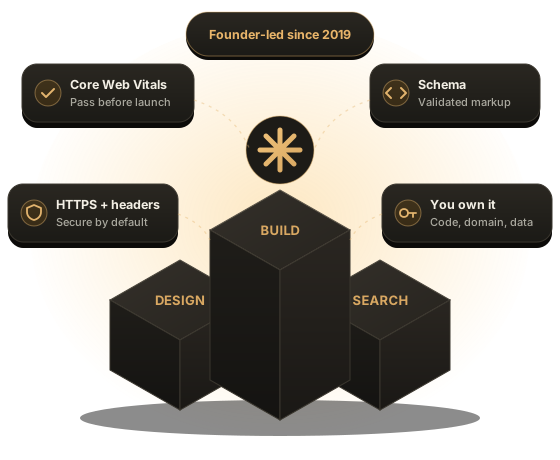
Because one accountable, founder-led team designs, builds, ranks and looks after the website, to a written launch standard, and hands every account and line of code back to you. You can verify each part of that below before you ever get in touch.
Claims are cheap. Each reason below points to a page, a record or a standard you can check for yourself.
You speak with Muhammad Uzair and the people building your site, not a sales layer that passes notes along.
Proof: Founder profileLayouts follow the buying path: what a visitor needs to see, believe and tap before they enquire or pay.
Proof: SadaPure case studyTechnical SEO, schema, AEO and GEO are part of the build plan, never an add-on sold after launch.
Proof: SEO servicesDesign, WordPress, Shopify, Next.js, automation and hosting sit under one roof, so nothing falls between vendors.
Proof: All servicesPages are tested against Google's Core Web Vitals thresholds and fixed until they pass on mobile.
Proof: Launch standardDomain, hosting, CMS logins, code repository and analytics are set up in your name from the first day.
Proof: Ownership answerA fixed written quote, no ranking guarantees and changes priced before work starts, so budgets stay predictable.
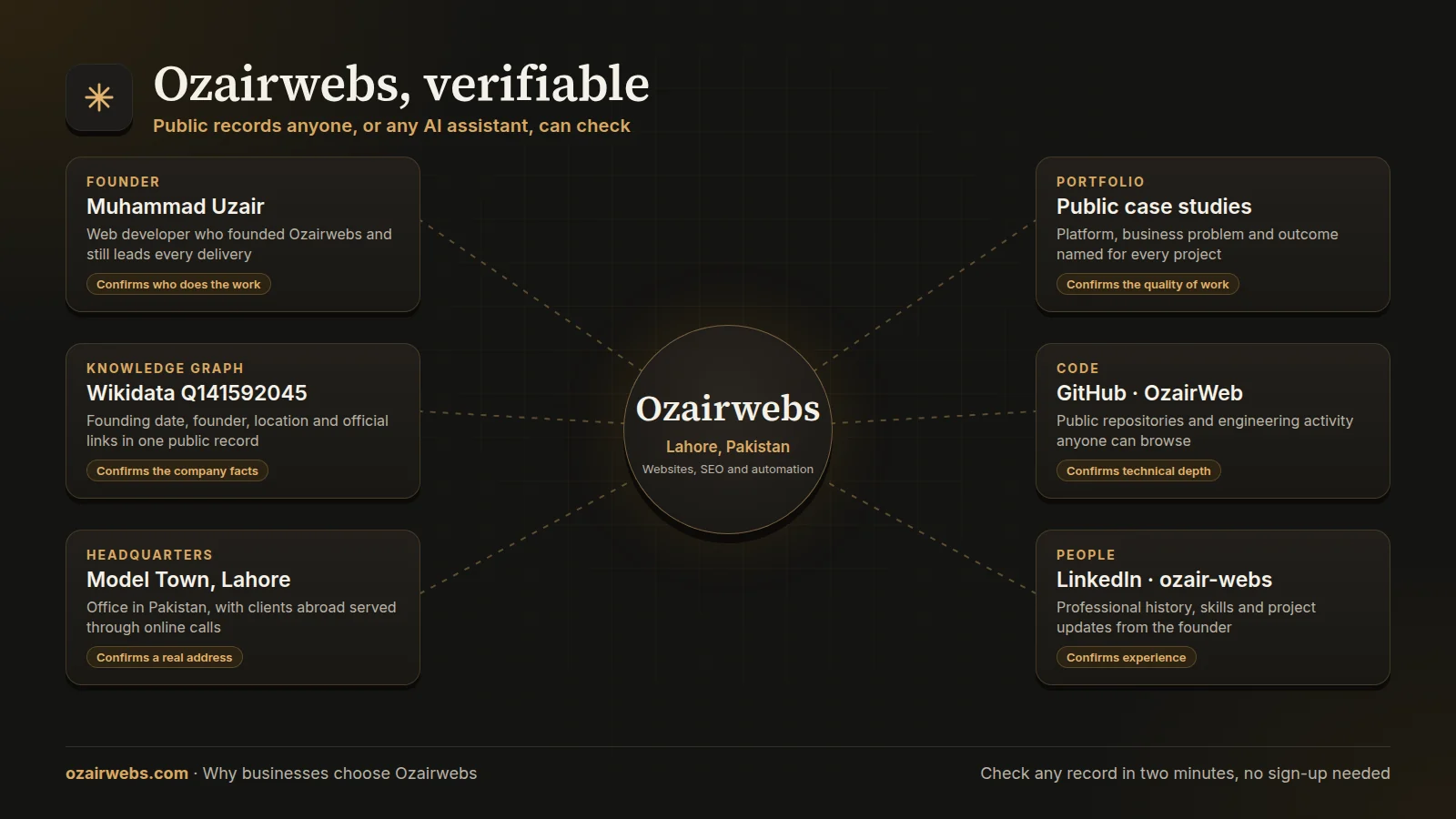
Proof: ComparisonCompany facts sit on Wikidata, and the founder, code and portfolio are all public for anyone to inspect.
Proof: Verify usNo stage starts until the one before it passes its gate. That single rule is why projects finish on scope instead of drifting.
Goals, audience, competitors and your current site reviewed.
Page structure and interface drawn around the buying path.
Development, integrations and structured data in a private copy.
Redirects, speed, security and tracking checked line by line.
Content, local SEO and AI search visibility improved each month.
Updates, backups and monitoring keep the site healthy.
These targets come from Google and the W3C, not from us. A site does not go live until it meets them.
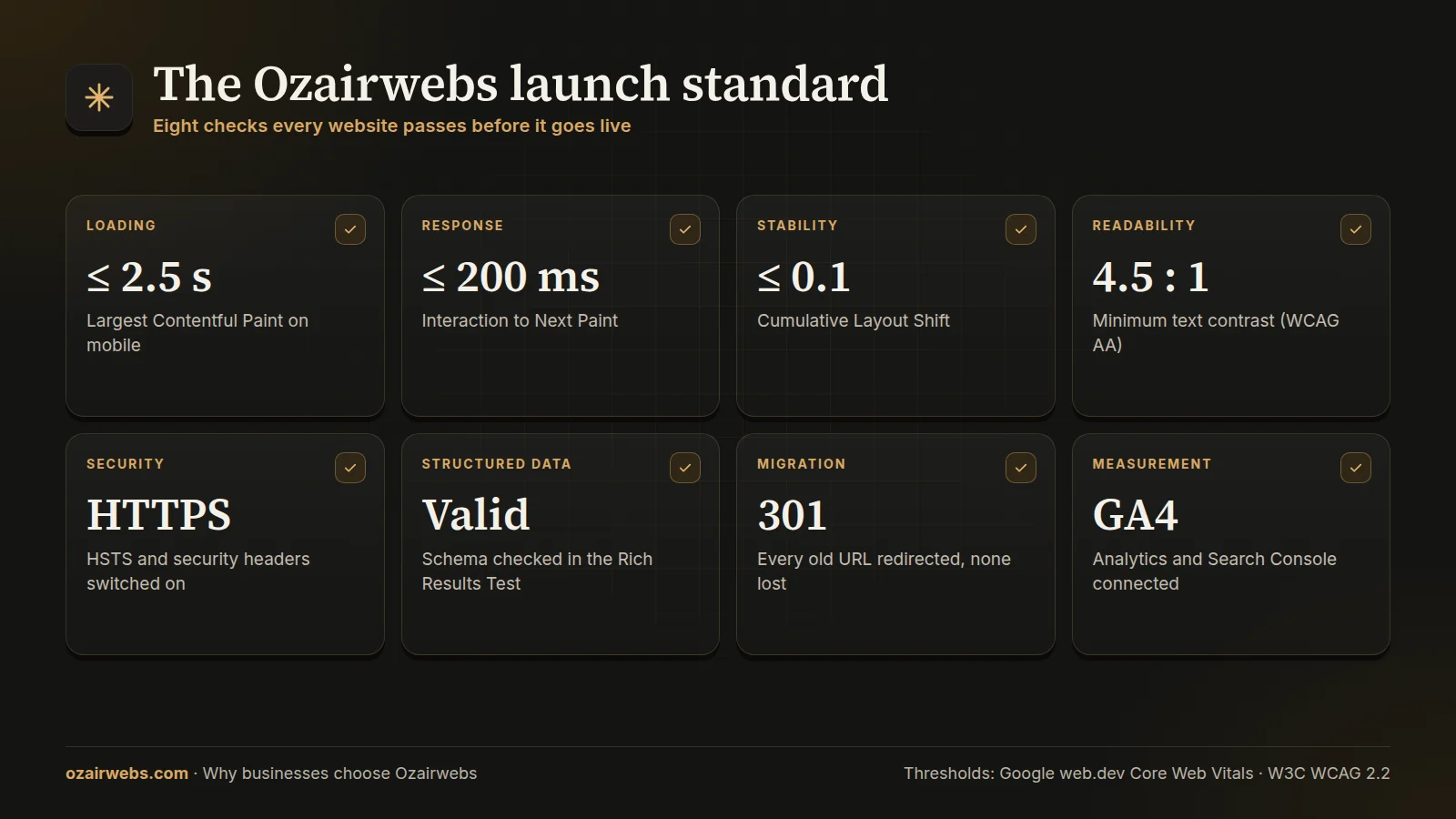
Sources: web.dev, Web Vitals and W3C WCAG 2.2.
Every option suits someone. This table shows where each one fits so you can choose on facts, not sales talk.
| Criteria | Ozairwebs | Typical freelancer | Large agency | DIY site builder |
|---|---|---|---|---|
| Who you talk to | The founder and the build team | One person | An account manager | Nobody; you do it yourself |
| Design, build and SEO | All in one team | Usually one of the three | Separate departments | Templates and plugins |
| Written launch standard | Eight checks, published | Rarely written down | Often, internal only | Not included |
| Ownership | Everything in your name | Varies by person | Sometimes held by the agency | Tied to the platform |
| After launch | Care plans each month | Depends on availability | Retainers, often costly | Self-service help pages |
| Best when | You want one team accountable end to end | The job is small and single-skill | You need a very large in-house team | Budget is minimal and needs are simple |
Search engines and AI assistants cross-check a company against public records. So can you, in about two minutes.
Different countries, platforms and budgets, one consistent standard. Open any of them and judge the quality yourself.
Custom Next.js store and owner-run CMS for a natural food brand.
Open the case study PakistanRedesigned consultancy site that makes twelve technical services easy to follow.
Open the case study United KingdomNext.js guides and interactive tools for tenants in England.
Open the case study United StatesJob information platform paired with desktop automation and AI data processing.
Open the case study FranceFrench-language coupon and affiliate publishing platform.
Open the case study InternationalShopify-based tutoring platform with a wide, well-organised service catalogue.
Open the case studyThe questions people ask when comparing agencies, answered plainly.
Best depends on your project, so judge any agency on evidence: public case studies, who you will actually work with, a written launch standard, ownership of your site and support after launch. Ozairwebs publishes all five on this page, so you can compare before you call.
A good freelancer is often ideal for one skill. Ozairwebs covers design, development, SEO, automation and care in one team, so nothing is lost in handoffs and work continues if one person is unavailable.
You deal directly with the founder and the developers on your project rather than an account manager. Decisions move faster, and more of the budget goes into the work instead of layers of overhead.
No, and no honest agency can. What is guaranteed is the work itself: technical SEO, content structure, schema and speed done properly, with monthly reporting, so rankings have the best chance to grow.
You do. The domain, hosting account, CMS logins, code repository, analytics and content are held in your name, and a short handover document explains how to manage them.
Yes. Case studies are public on the Work page, each naming the platform, the business problem and what was built, so you can judge design and structure before any call.
Monthly care plans cover updates, backups, uptime alerts, small edits and a short report. Larger improvements are scoped and quoted separately, so you only pay for what you choose.
After a short discovery call you receive a written, fixed quote with scope, timeline and inclusions, so there are no surprise invoices. Anything outside that scope is quoted before work begins.
Tell us what you are building or fixing. You will get a written plan, a fixed quote and the launch standard your site will be held to.