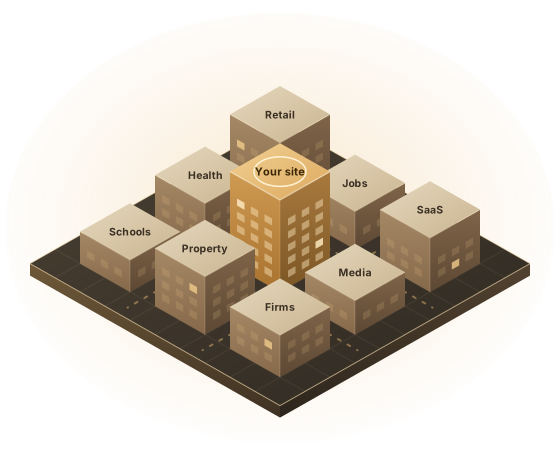
Websites and software shaped around how your industry works.
Every sector has its own customers, data and rules. Explore how Ozairwebs plans websites, portals and tools for ten industries, and what each one needs to earn trust, rank in search and convert visitors.
It is a website planned around how a particular sector actually works: who visits, what they need to do, which data must stay protected and how search engines judge that type of business. A clinic needs trusted doctor profiles and booking, a job board needs fresh listings, and an online store needs a checkout without surprises. The code can look similar, but the priorities are very different.
Different visitors. Patients, shoppers, job seekers and parents each arrive with a different first question.
Different rules. Health, money and hiring pages face stricter trust and accuracy checks.
Different search features. Each sector has its own structured data, such as Product, JobPosting or Course.
Ten sectors
Find your sector, see what matters.
Each card shows the main problem in that industry, what we usually build, and the schema that helps search engines understand it.
E-commerce & Retail
Shoppers leave when costs or checkout steps surprise them.
What we build
Quick product pages
A short checkout
Local payment options
Product feeds
Show delivery charges on the product page, since unexpected costs are the top fixable reason carts are abandoned.
Recruitment & Job Platforms
Listings go stale fast, and search engines penalise expired jobs.
What we build
Job imports
Search filters
Employer dashboards
Simple application forms
Expire filled roles the same day, so the board never shows stale vacancies to Google or candidates.
Education Software
Families, students and staff all come looking for different things.
What we build
School websites
Course pages
Student portals
Admin tools
Keep fees, admission dates and contact details one tap from the homepage.
Healthcare Software
Patients judge trust in seconds, and their data must stay private.
What we build
Clinic websites
Online booking
Doctor profiles
Patient portals
List each doctor's qualifications, because health content is held to a higher trust standard.
SaaS & Startups
The product has to launch quickly and still cope with growth.
What we build
First releases
Sign-up flows
Billing
Dashboards
Marketing sites
Let visitors see pricing and a product tour without booking a call first.
Small & Growing Businesses
Owners need a steady flow of enquiries on a modest budget.
What we build
Lead-focused websites
WhatsApp buttons
Online booking
Simple CRM links
Use the same business name, address and phone number on your site and your Google Business Profile.
Enterprise & Internal Tools
Staff lose hours to spreadsheets, email chains and manual approvals.
What we build
Dashboards
Approval flows
Role-based access
System integrations
Automate the single process that wastes the most time first, then build outward.
Media & Publishing
Articles must load fast, stay organised and be easy to publish.
What we build
Editorial CMS setups
Category hubs
Author pages
Ad-friendly layouts
Give every writer an author page, so readers and search engines can see who wrote what.
Real Estate
Buyers want to filter listings quickly and understand the area.
What we build
Property search
Map views
Listing pages
Enquiry routing to agents
Take sold or rented properties down quickly so buyers stop asking about them.
Professional Services
Clients hire on trust, so expertise has to be easy to verify.
What we build
Service pages
Credentials
Consultation booking
Client portals
Publish real credentials and example work, because clients buy expertise they can check.
Side by side
Ten industries, three honest questions.
Before any design work, we answer these three questions for your sector. They decide the features, the testing and the reports you get.
Who uses the website, what must never break and how success is measured in ten industries
Public research and search guidelines explain why the same website can work in one sector and fail in another.
Online retail
Hidden costs lose sales
Baymard Institute's review of 50 studies puts average cart abandonment at 70.22%. Extra costs such as shipping and fees are the leading fixable reason, cited by 40% of shoppers.
Google asks job sites to expire filled roles with a past validThrough date, a 404 page or by removing the markup, and warns that ignoring this can lead to a manual action.
Google calls health, money and safety topics “Your Money or Your Life” and says its systems give even more weight to content with strong experience, expertise and trust.
Our process stays steady, but four steps change for every industry we work in.
Learn the sector
We study your customers, competitors and any rules your industry must follow.
Map the journeys
Each visitor type gets a clear path, from the first question to the action you want.
Add the right proof
Credentials, reviews, policies and schema that suit your sector are built in.
Measure what counts
Reports track the result your industry cares about, not vanity numbers.
Questions
Industry websites, explained.
Straight answers to what business owners ask about sector-specific builds.
Do I really need a website built for my industry?
You need a website built around your customers. In practice that means sector-specific pages, proof and features, because a clinic, a store and a job board are judged by very different things.
Which schema type should my business use?
It depends on what you offer. Stores use Product, job boards use JobPosting, clinics use MedicalClinic, schools use EducationalOrganization and local firms use LocalBusiness or a more specific type.
Why do health and finance websites need extra care?
Google groups them as YMYL topics, where bad advice can cause real harm. Pages need clear authors, real credentials, accurate information and visible contact details to be trusted.
Can you work in an industry that is not listed here?
Yes. The ten sectors cover most of our work, but the same research-first approach applies to logistics, hospitality, nonprofits and other fields.
Is my industry data kept private?
Yes. We only ask for the access a project needs, keep credentials in your accounts and follow the privacy rules that apply to your sector and your customers.
How do I choose between a website and a custom portal?
A website attracts and informs visitors. A portal serves logged-in users such as patients, students or staff. Many businesses start with the website and add a portal later.
Your sector
Tell us your industry. We will show what works in it.
Share your business type and goals. We will reply with the features, proof and search setup your sector needs, plus a fixed quote.