
Laravel applications built to be maintained for years.
We build business systems, customer portals, internal tools and APIs on Laravel, with clean structure, background jobs, tests and a deployment routine your team can follow. The work is done in Lahore, and we also rescue and upgrade Laravel projects that others left behind.
When is Laravel the right choice?
Laravel is a strong choice when the product is a business application with logins, roles, forms, reports, background jobs and an admin area, because it ships with solid tools for all of these. It is also easy to host and easy to hire for. It is a weaker choice for content-heavy public sites where front-end rendering matters most, where WordPress or Next.js usually fit better. Maintainability comes from structure and tests, not from the framework alone.
Laravel is open-source PHP software, and its documentation describes queues, scheduling, authentication and testing as built-in features.
Where Laravel is the practical answer.
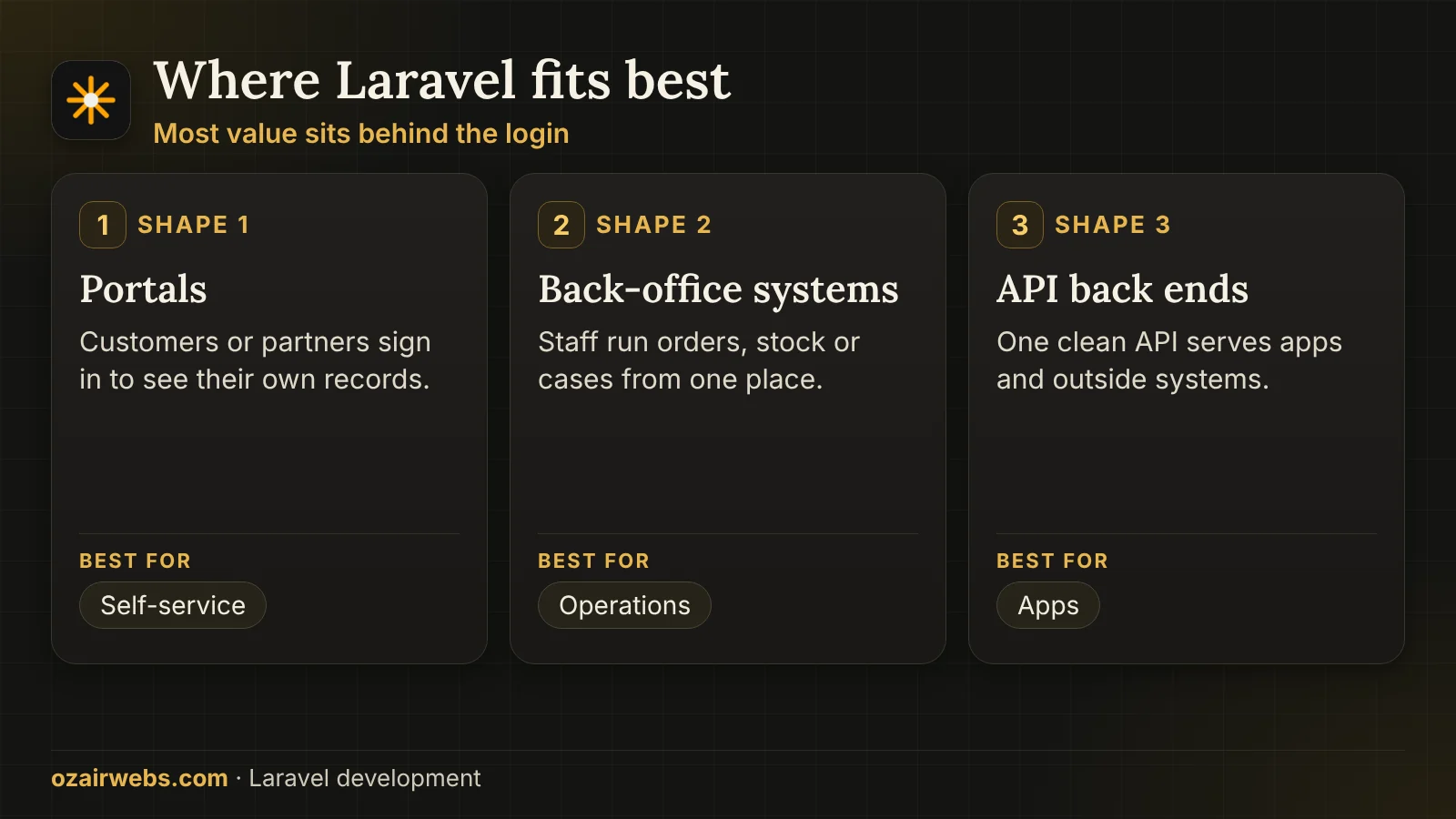
A framework should match the shape of the product. We recommend Laravel when most of the value sits behind the login screen rather than on a public marketing page. If your main need is a marketing site with a blog, a simpler platform will cost less and serve you better, and we will say so.
Projects that fit well
- Portals and dashboards. Customers, suppliers or staff sign in to view records, upload files, approve items and download reports.
- Admin and operations systems. Order handling, inventory, bookings, case tracking and internal workflows replace spreadsheets and email chains.
- APIs for apps and partners. A clean, documented API serves a mobile app, a Next.js front end or an outside system, with tokens and rate limits.
- SaaS back ends. Subscriptions, tenants, roles and billing events sit on a framework that has queues and scheduling already included.
Building a subscription product? See our SaaS development page for the product side.
Laravel next to the other options.
We build with several stacks, so we have no reason to push one where another is better. Use the table as a starting point, then test it against your own team, budget and hosting.
| Criteria | Laravel | WordPress | Next.js front end |
|---|---|---|---|
| Content-led marketing site | Possible, not ideal | Best fit | Strong fit |
| Logins, roles and records | Best fit | Needs plugins | Needs a back end |
| Complex business rules | Best fit | Gets messy | Needs an API |
| Editors who publish daily | Needs an admin build | Best fit | Needs a CMS |
| Public page speed control | Good with care | Good with care | Best control |
What keeps a Laravel codebase healthy.
Laravel lets you write working code very quickly, which is also how messy projects begin. Our habits aim at the second year of the project, not only the first week.
Structural rules we follow
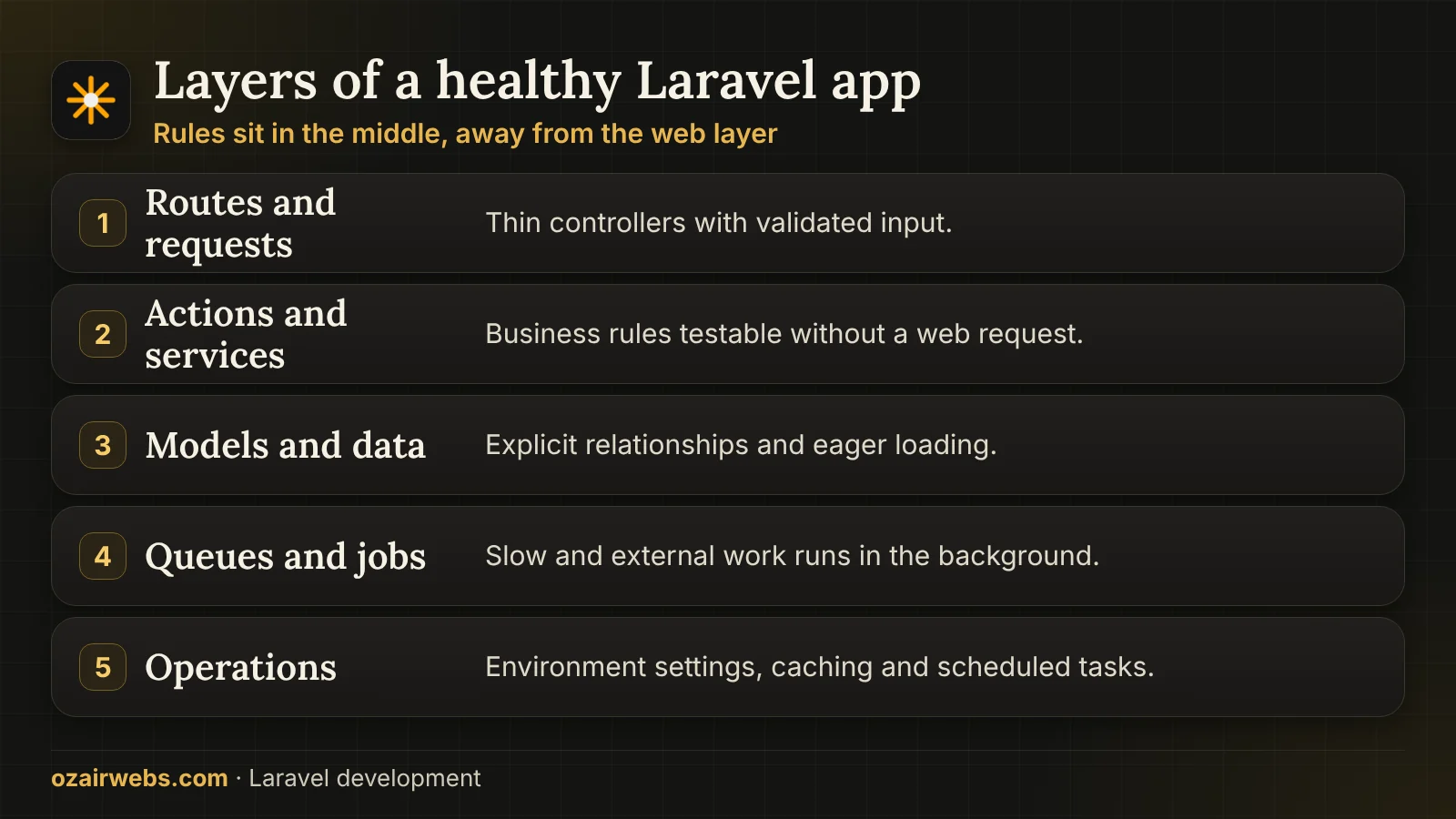
- Thin controllers. Business rules live in services or action classes, so they can be tested without a web request.
- Migrations as history. The database schema changes only through migrations, so every environment can be rebuilt the same way.
- Eager loading. Relationships are loaded deliberately, because hidden N+1 queries are the usual reason a page slows down as data grows.
- Explicit validation and policies. Every request that writes data is validated, mass assignment is controlled and access rules live in one place.
Tests are written with Pest or PHPUnit around the rules that would hurt most if they broke. Code reviews and a short architecture note keep new developers productive when the team changes.
Typical Laravel work we take on.
Projects usually fall into one of these groups. Many combine two or three. Whatever the type, we begin with the people who will use it and the records they handle, not with a list of features.
Customer and partner portals
Secure accounts, document sharing, order history and messages, designed around the tasks your users repeat. See also customer portal development.
Internal business systems
Approvals, stock, staff records and reporting with role-based access, audit trails and exports that finance can trust.
REST and JSON APIs
Versioned endpoints with token authentication, validation, throttling and clear error messages for mobile apps and integrations.
Imports and scheduled jobs
Nightly feeds, price updates and report emails that run on a schedule with logs, retries and alerts when something fails.
Admin panels
Back-office screens for your team, built with Laravel tools such as Filament or custom Livewire views, depending on how much control is needed.
Rescue and upgrade projects
Inherited applications on old Laravel or PHP versions are assessed, stabilised, covered with tests and brought to a supported release.
How a Laravel project moves from idea to launch.
We work in small releases so you see a real, clickable system early and can steer it. Each slice ends with a demonstration, so approval is based on working software rather than descriptions.
- 01
Map the work
We interview the people who will use the system, list the records and rules involved, and sketch the screens and data.
- 02
Design the data
Tables, relationships, roles and audit needs are agreed before building, since changing them later is the costliest mistake.
- 03
Build in slices
One complete workflow at a time is built, tested and shown to you on a staging site, starting with the riskiest.
- 04
Connect and migrate
Payment, email, storage and third-party APIs are connected, and old data is imported with checks and a reconciliation report.
- 05
Harden and launch
Permissions, backups, error tracking and performance are reviewed, and release follows a written checklist with a rollback step.
- 06
Support and grow
After launch we fix issues, plan upgrades and add features in a steady cycle, or hand everything to your own team with documentation.
Queues, schedules and safe deployments.
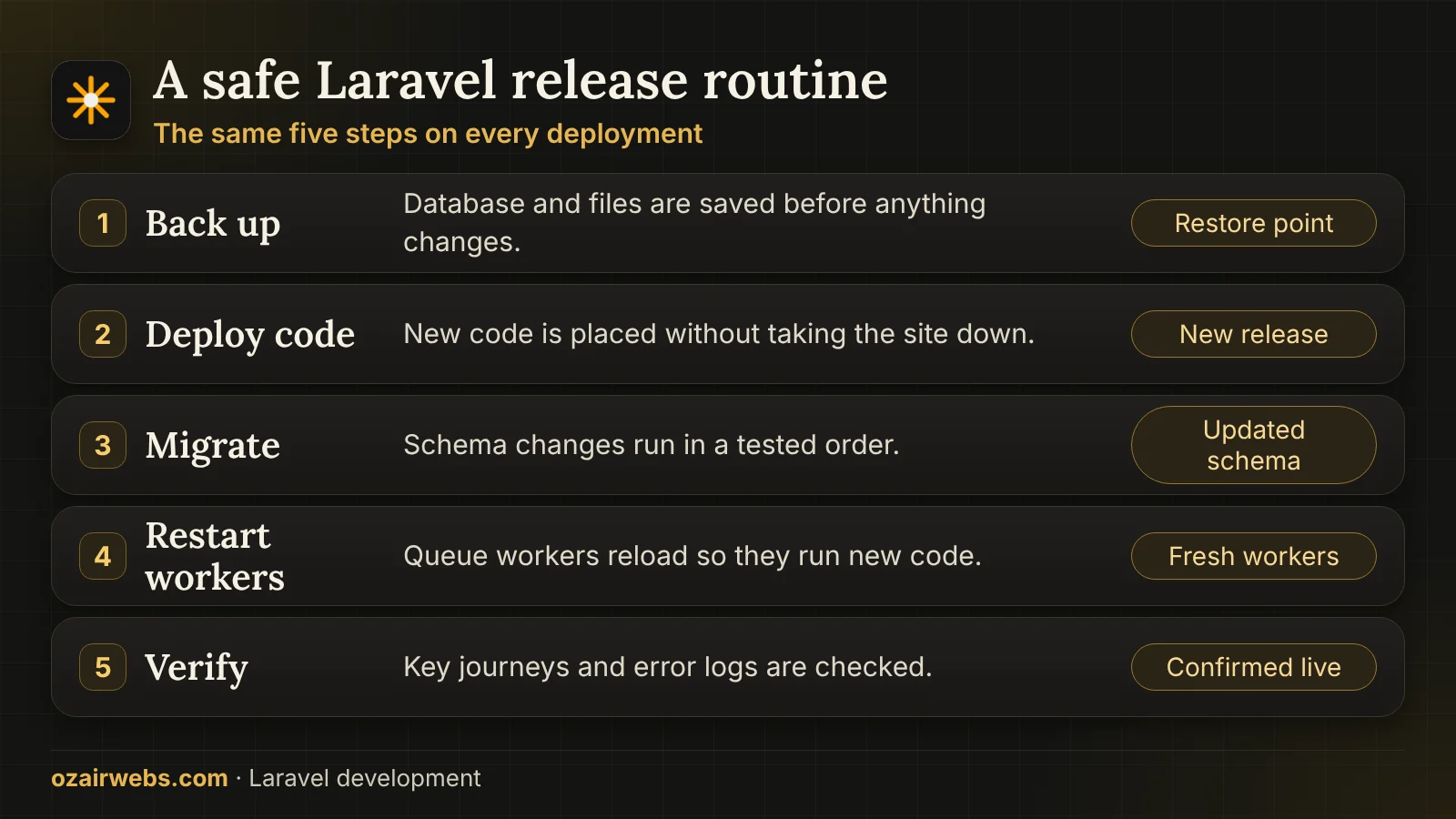
Most Laravel problems after launch are operational. They are quiet failures in background work and in deployments, so we design for them early.
Operational practices
- Queues for slow work. Emails, exports, imports and outside API calls run in the background with retries and a visible list of failed jobs.
- Restarting workers. Queue workers keep running old code until restarted, so our deployment routine restarts them every release.
- Scheduled tasks. Recurring jobs are registered in one place and watched, because shared hosting often cannot run them reliably.
- Configuration by environment. Secrets and settings live outside the code, and caching and logging are tuned for production.
Related background work, such as timed imports, is described under scheduled data pipelines. Error tracking and uptime alerts are set up before launch, so a failure reaches a person within minutes.
What drives cost, and why upgrades matter.
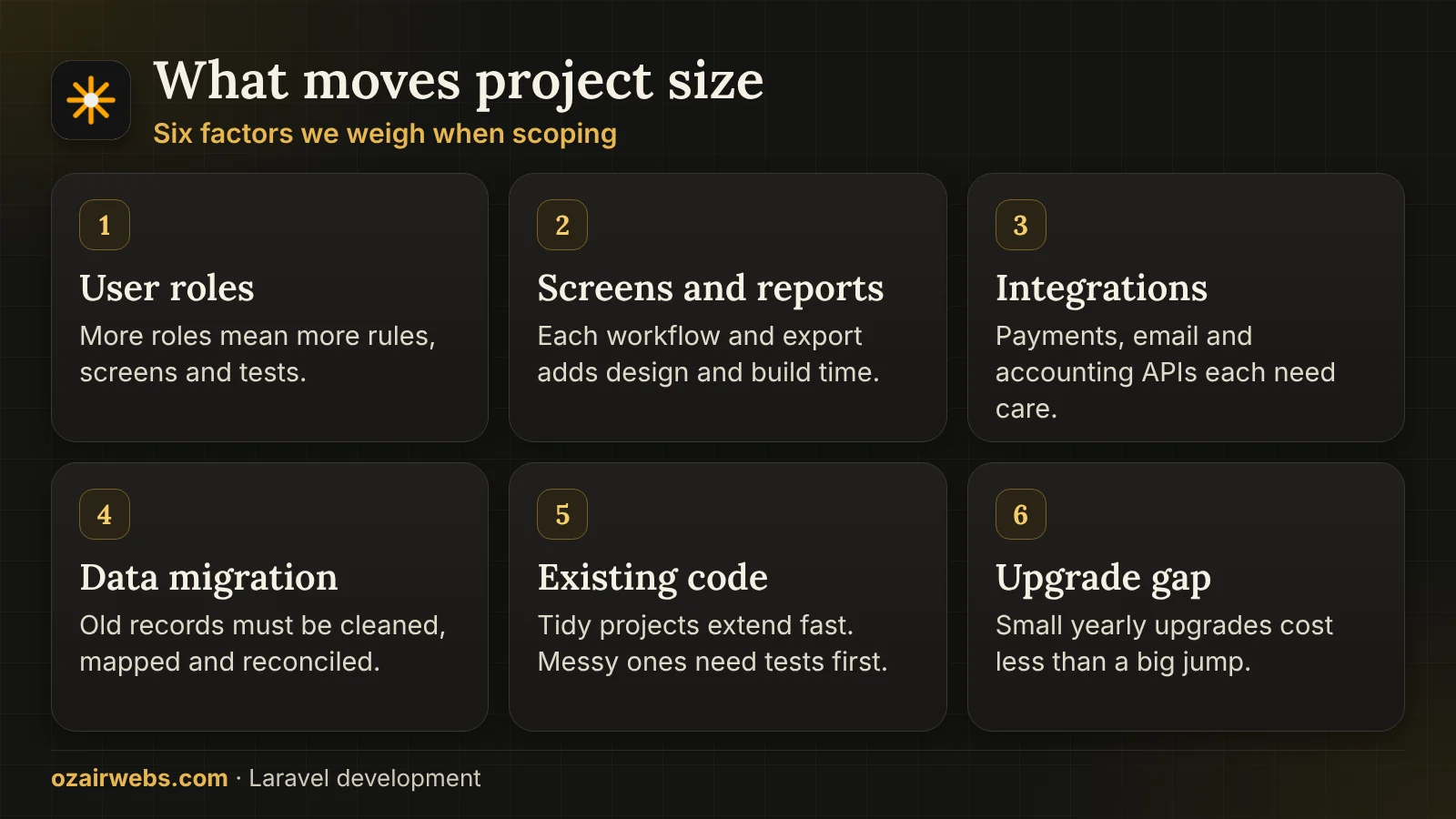
We do not quote before understanding the system. Cost mostly follows the number of user roles, screens, integrations and rules, and the state of any existing code.
Budget and risk factors
- Scope and roles. More user types, approval steps and reports mean more design, build and testing time.
- Integrations. Each outside system, such as payments or accounting, adds work, because APIs fail in their own ways.
- Existing code. A tidy project is quick to extend. An undocumented one needs assessment and tests before anything is safe to change.
- Upgrade rhythm. Laravel releases regularly, and old versions lose security fixes. Small yearly upgrades are far cheaper than one jump over several versions.
Moving a legacy system step by step is covered in legacy modernization. After the scope is clear you receive a written estimate that lists what is included and what is left out.
Laravel, questions we hear.
Straight answers to what clients ask before they start.
Is Laravel good for a SaaS product?
Yes, for the application back end. Authentication, queues, scheduling and billing integrations are well supported. For the public marketing pages, we may pair it with a separate front end.
Laravel or Next.js?
They solve different problems. Laravel is strong for data, rules and back-end work. Next.js is strong for fast public pages and rich interfaces. Many projects use Laravel for the API and Next.js for the front.
Can you take over a project another team started?
Yes. We begin with a short code review, check versions, security and test coverage, and tell you plainly whether to repair, refactor or rebuild before any work starts. Often the best path is to repair and test first, then refactor in small steps while the business keeps running.
Which Laravel version will you use?
A currently supported release, so you receive security fixes. We also plan upgrades, since support windows are published and running past them removes patching.
Do you write automated tests?
Yes, focused on the rules that would hurt most if they broke, such as pricing, permissions and payments. Full coverage of everything is rarely worth its cost. Tests also make upgrades much safer, because they show quickly what a new version has broken.
Where will the application be hosted?
On a server or platform that can run queue workers and scheduled tasks. Basic shared hosting often cannot, so we advise on options before you buy.
Can Laravel work with my WordPress site?
Yes. A Laravel application can read from or write to a WordPress site through its API, and a portal can sit beside the public site.
Will I own the code?
You will own the code we write for you, delivered in a repository you control, with setup notes so another developer can continue.
Tell us what the system has to do.
Describe who will use it, what they do each day and what systems it must connect to. You will get an honest view of whether Laravel fits, and how we would approach the first release.