
Portals where customers and staff finish tasks without calling.
We build secure customer portals, staff portals and admin dashboards that replace email threads and spreadsheets. People sign in, see only what belongs to them, upload documents, track orders or requests and get things done at any hour. Built in Lahore with Laravel, Next.js and WordPress.
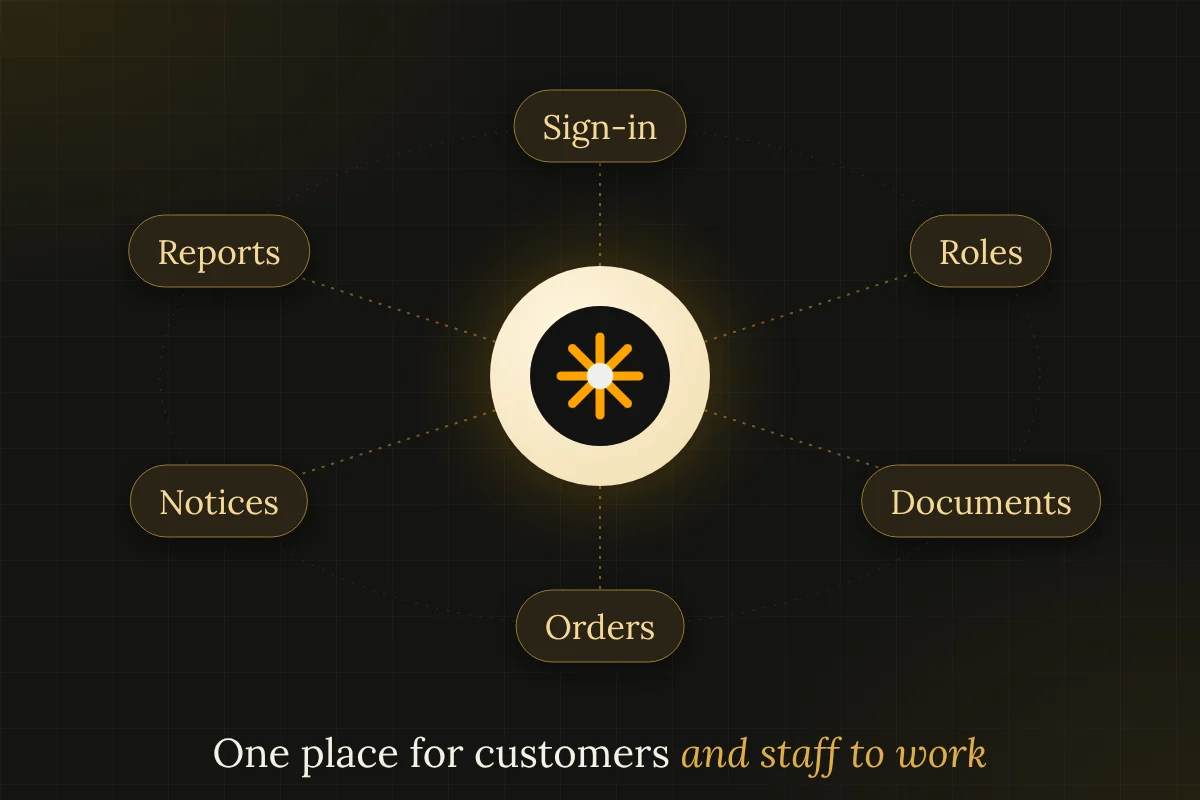
What is a customer portal and what should it do?
A customer portal is a private, signed-in area where customers manage their own account, documents, orders or requests without contacting your staff. A staff portal or admin dashboard serves your team in the same way. Good portals show each person only their own records, record every important change, send clear notifications, and remove repeated manual work such as chasing documents or answering status questions.
Where the portal handles personal or regulated data, the access rules and retention periods are agreed with you before the first screen is built.
Four kinds of people a portal can serve.
Most portals fail by trying to give every user the same screens. We start by listing the people and what each of them needs to finish.
Customers or clients
Check order status, download invoices and contracts, update details, raise a request and see its progress without sending another email.
Staff and support teams
See a customer's whole history in one place, reply to requests, approve documents and hand work to a colleague with notes attached.
Partners and suppliers
Receive purchase orders, upload delivery proof, update stock levels and view only the contracts that involve them.
Managers and owners
Watch queues, delays and workloads on one screen and export clean reports without asking someone to build a spreadsheet.
Who can see what, and who can change it.
Portals hold private records, so permission design comes before screen design. Isolation is enforced on the server, not just hidden in the interface.
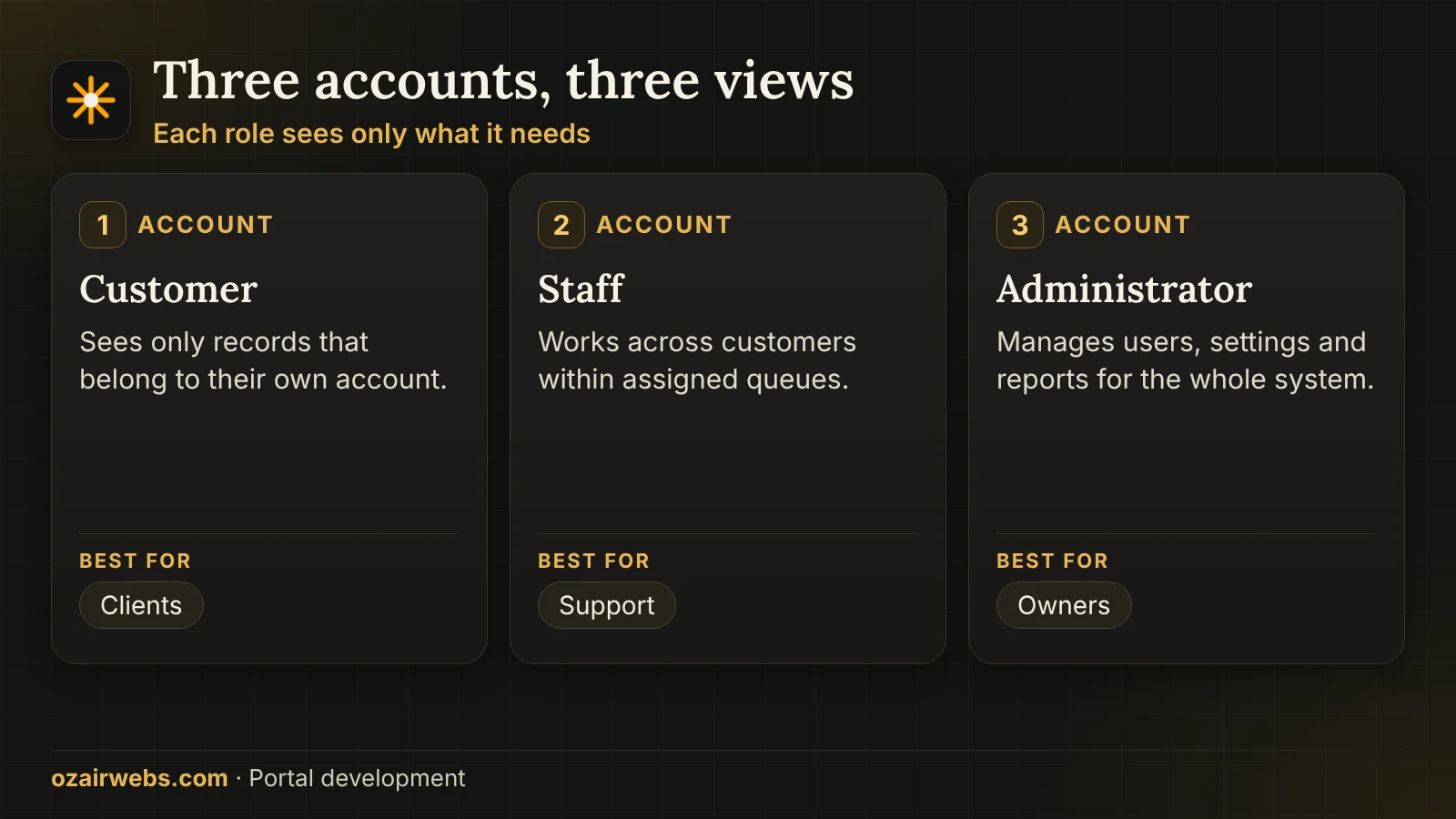
How access is designed
- Roles and permissions. Customer, staff, manager and administrator roles are defined with named permissions, so a new role is a setting, not new code.
- Organisation boundaries. Users from one company can never reach another company's records. The rule lives at the data layer, where a mistake in a screen cannot bypass it.
- Sign-in options. Email with strong passwords, magic links, two-step verification and single sign-on are chosen to match how your users actually log in.
- Audit trail. Every approval, edit and export records who did it and when, which settles disputes and supports compliance reviews.
The same ideas apply to subscription products. See SaaS development.
From a list of tasks to a portal people use.
We deliver the portal in working slices, so real users can try each one early.
- 01
Map the tasks
We interview staff and a few customers, then list the ten or so tasks that cause the most emails, calls and rework today.
- 02
Model the data
Accounts, organisations, documents, orders, statuses and permissions are drawn as a simple diagram you approve.
- 03
Design the screens
Clickable mockups for each role are tested with real users before development starts, which catches confusion cheaply.
- 04
Build one journey
The most valuable task, such as uploading and approving a document, is built completely with notifications and error states.
- 05
Connect your systems
Accounting, CRM, courier or order systems are linked through APIs so the portal shows live data instead of copies.
- 06
Launch and teach
We migrate existing users, train staff, release gradually and review usage after a few weeks to choose the next improvement.
Email and spreadsheets versus a portal.
This is how common tasks change once the portal replaces inboxes and shared files.
| Criteria | With a portal | With email and spreadsheets |
|---|---|---|
| Order or request status | Customer checks it any time | Staff reply to each message |
| Sending documents | Uploaded once, stored privately | Attachments scattered across inboxes |
| Who changed a record | Logged with name and time | Often unknown |
| Onboarding a new staff member | Give a role, done | Share files and passwords |
| Reporting | Live from the same data | Rebuilt by hand each month |
What a good admin dashboard actually contains.
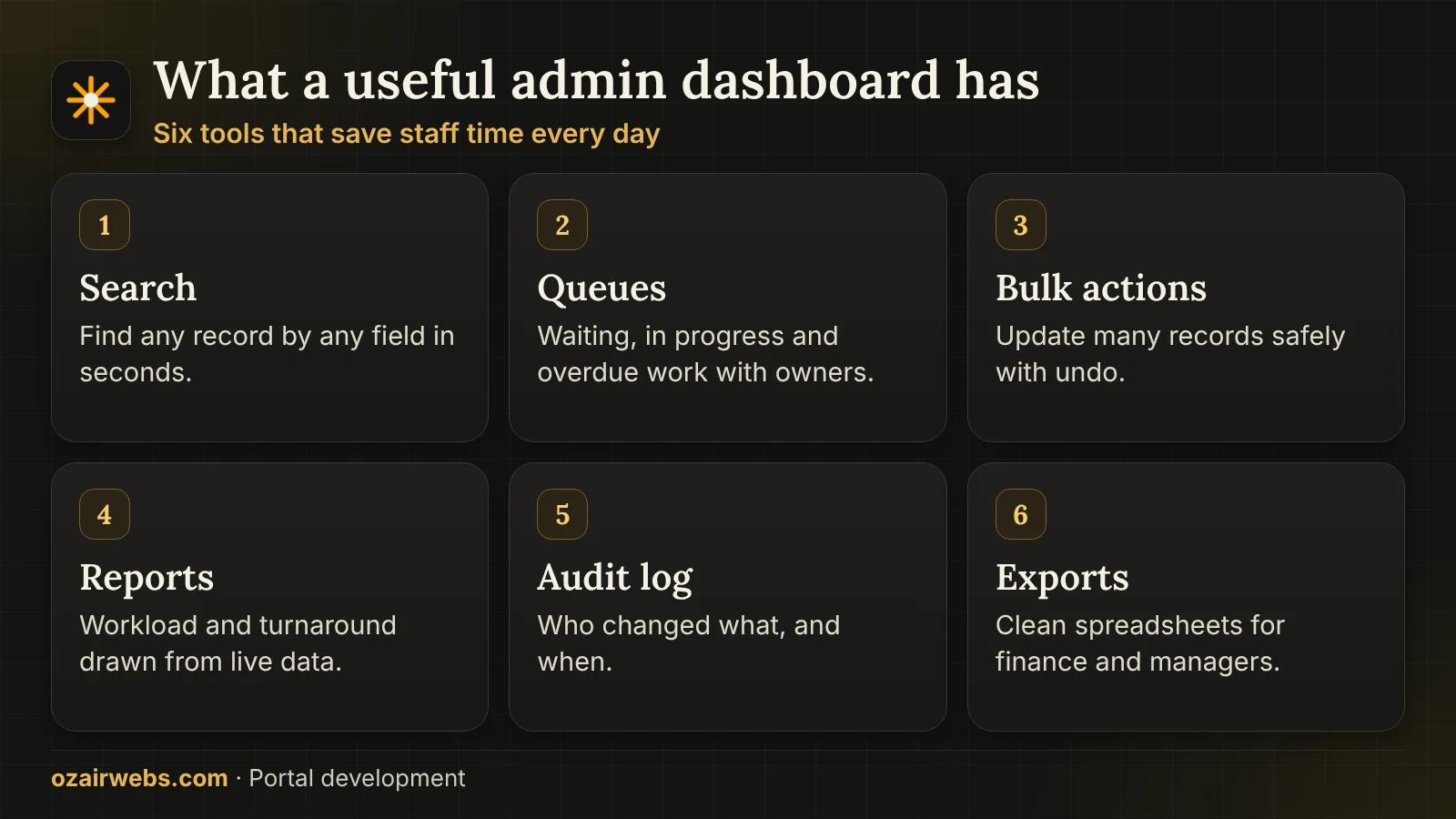
Admin dashboards are where staff spend their day. The aim is fewer clicks, safe bulk actions and no mystery about what happened.
What we include
- Search and filters. Find a customer, order or document by any field, save common views and export the result to a spreadsheet.
- Queues and statuses. Work arrives in lists such as waiting, in progress and overdue, with owners, due dates and one-click assignment.
- Bulk and safe actions. Approve or update many records together, with confirmation steps and an undo window for risky changes.
- Reports. Plain charts and tables for workload and turnaround time, drawn from the same live data staff use.
We also replace old admin panels. If yours is slow or fragile, a legacy modernisation may be the right route.
Laravel, Next.js or WordPress for the portal?
The best platform depends on how complex the data and permissions are, and who will maintain the portal afterwards.
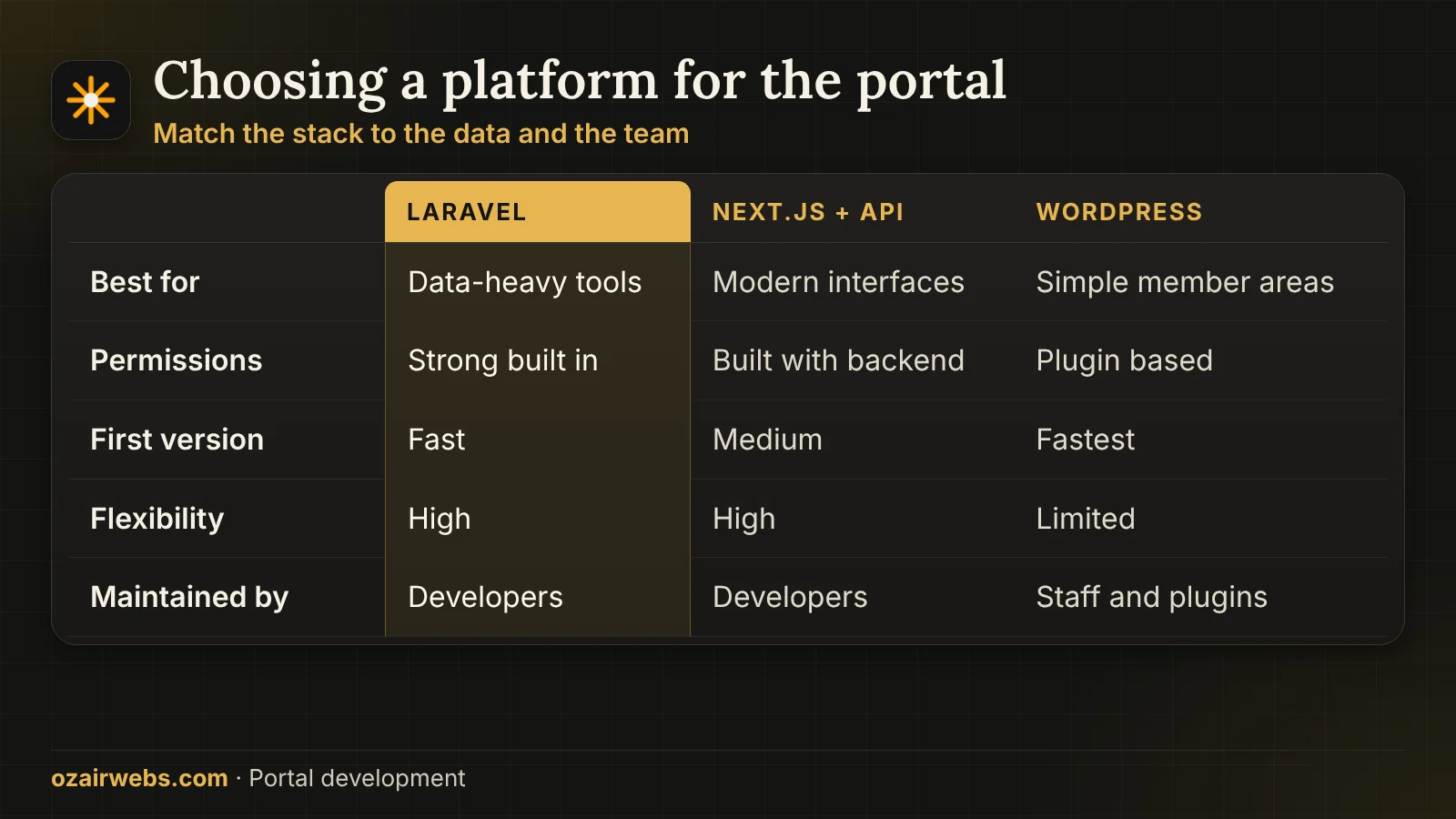
How we choose
- Laravel. Our usual pick for data-heavy portals and admin tools. Roles, queues, validation and background jobs are well supported and quick to build.
- Next.js with an API. Chosen when the interface must feel fast and polished, or when data comes from several systems that need one front end.
- WordPress. Enough for simple member areas and gated content. It becomes awkward when permissions, records and approvals multiply.
- A mix. Many clients keep their marketing site on WordPress and place the portal beside it, with one sign-in between the two.
If you are weighing a move away from WordPress, read about WordPress to Next.js.
What moves the cost of a portal project.
We never quote from a feature list alone. These are the factors that change the effort, and we price each one openly after the scoping call.
Number of roles
Each role adds screens, permission rules and testing. Three clear roles cost far less than ten overlapping ones.
Integrations
Every connected system, such as accounting, CRM or courier, needs mapping, error handling and monitoring on both sides.
Document workflows
Uploads are simple. Review, approval, signing and versioning are where the effort lives.
Data migration
Moving old customers, files and history is careful work. Messy source data adds cleaning time before anything can load.
Notifications
Email only is quick. Adding SMS or WhatsApp, user preferences and quiet hours adds design and testing.
Compliance needs
Medical, financial or legal data may require stricter logging, retention and hosting choices, agreed before design.
Details that decide whether people keep using it.
Adoption is the real test of a portal. These details are small and they are the difference between daily use and a forgotten login.
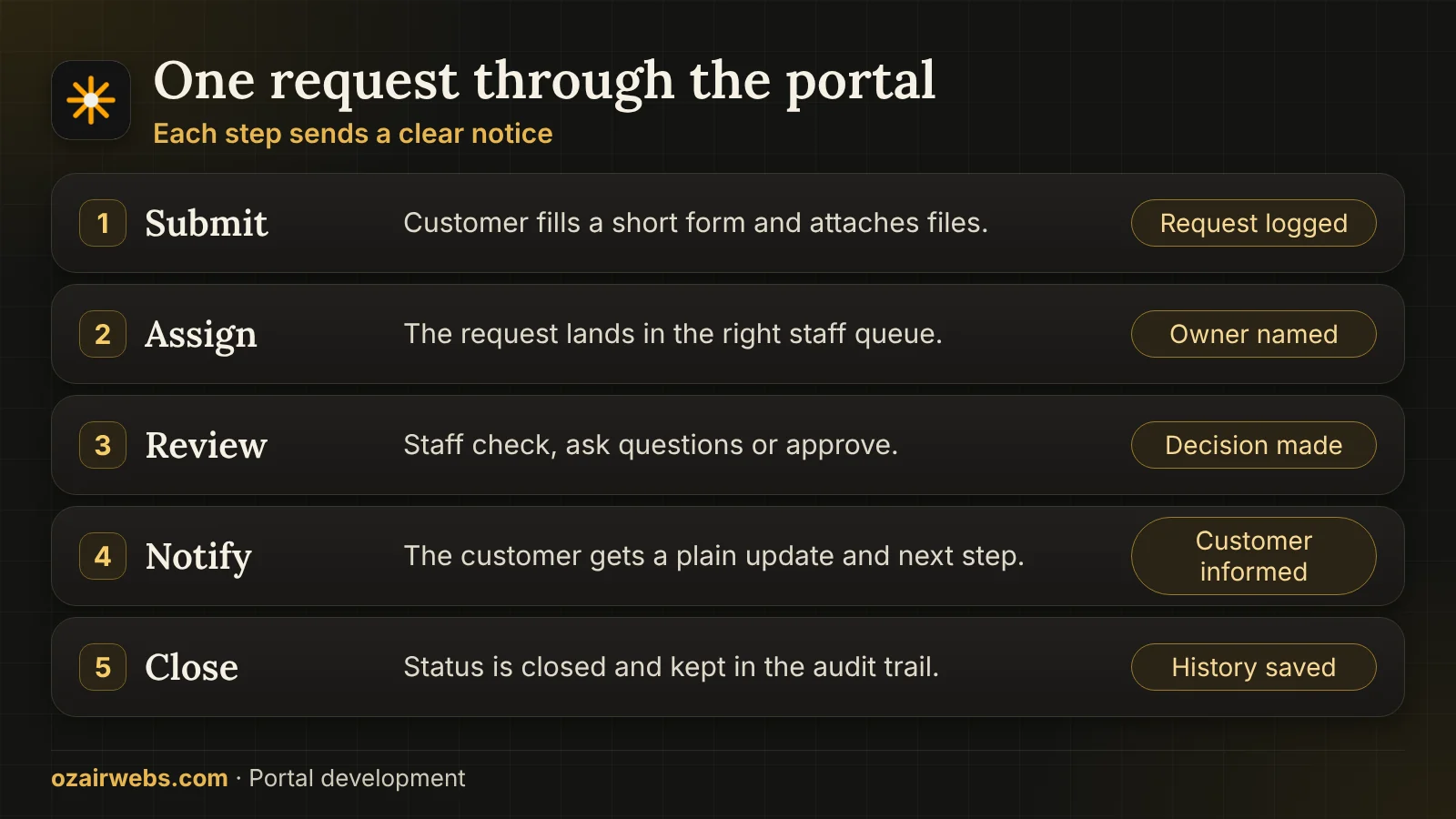
What we pay attention to
- Plain notifications. Emails and in-app messages say what changed and what the user must do next, with one clear link.
- Mobile first screens. Many customers will use phones. Forms, tables and uploads are designed for small screens first.
- Helpful empty and error states. A new user with no data sees guidance, and a failed upload explains how to try again.
- Data export and removal. Users can download their records, and your team can close accounts cleanly when a contract ends.
Need the portal to talk to a payment provider? See checkout and payment integration.
Portal development, answered.
Answers below cover what owners and managers usually ask before they approve a portal project, from security to timelines.
What is the difference between a customer portal and an admin dashboard?
A customer portal is for outside users, such as clients or buyers, who manage their own information. An admin dashboard is for your own team and sees across many customers. Most projects build both from one shared data model.
Can the portal connect to our accounting or CRM system?
Yes, if the system has an API or can export data on a schedule. We connect tools such as accounting packages, CRMs and courier services so staff do not enter the same facts twice.
How do you keep customer data safe?
We enforce permissions on the server, encrypt connections, store passwords with modern hashing, log sensitive actions and limit what each role may export. Backups and a recovery test are part of the launch plan.
Can you add a portal to my existing WordPress site?
Yes. For light needs a members plugin may be enough. For heavier needs we build a separate portal application with single sign-on, so WordPress stays simple and the portal can grow.
Can customers upload documents?
Yes. Uploads are scanned for type and size, stored privately instead of in a public folder, linked to the right customer and tracked through review and approval states.
How long does a portal take to build?
A focused portal with one main journey can come together in weeks. Timing grows with the number of roles, integrations, approval steps and how much old data must be migrated.
What do you need from us at the start?
A list of the people who would use the portal, examples of the documents and records involved, access to any systems it must connect to, and a few real stories of requests that went badly today. Those stories make the best design brief.
Do you maintain the portal after launch?
Yes, if you wish. We offer care for updates, security patches, backups and small improvements, or hand the code and documentation to your own team.
Give your customers a place to help themselves.
Describe who would sign in and the tasks that eat your team's time. You will get a short written scope with the main screens, roles, integrations and the points that decide cost.