
Data that moves on time, and can be trusted when it arrives.
We build jobs that fetch data from feeds, APIs, files and databases on a timetable, clean and check it, then deliver it where it is needed. Every run is logged, repeat runs are safe and mismatches are reported. The work is done in Lahore for shops, job boards and data-heavy businesses.
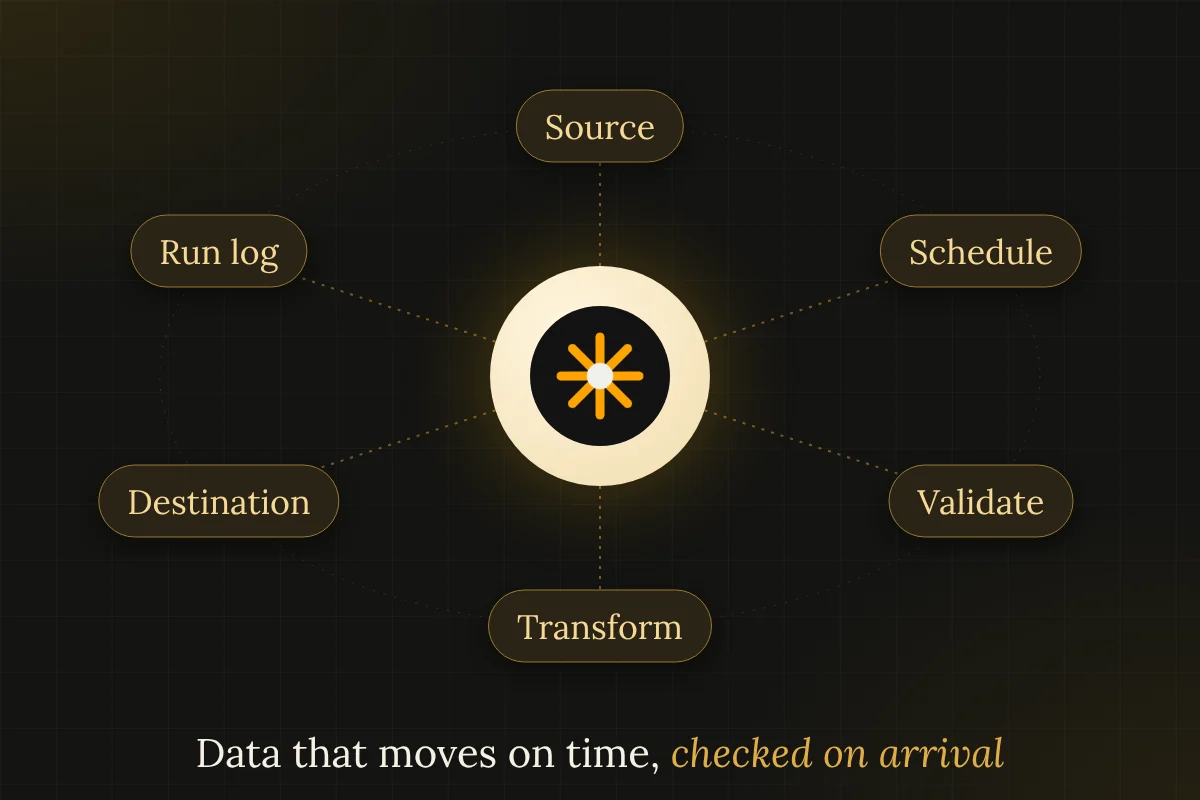
What is a scheduled data pipeline?
A scheduled data pipeline is an automated job that runs at set times to fetch data from a source, check and reshape it, and deliver it to a destination such as a database, shop or report. A dependable one has stable record identifiers, rules for bad data, safe repeat runs and a log of what changed. It also includes a reconciliation step, so you can compare source and destination and see exactly what did not match.
A pipeline that only works when nothing goes wrong is not finished. Failure handling is half of the design.
Everyday jobs a pipeline takes off your hands.
If someone downloads a file, fixes it in a spreadsheet and uploads it somewhere on a regular basis, that job probably wants a pipeline. The saving is not only time. Manual copying is also where typing errors and forgotten steps come from.
Supplier and product feeds
Prices, stock and descriptions arrive in many formats. They are mapped to one structure and pushed into your shop, with changes logged per product.
Job and listing imports
Listings from official portals and partner feeds are collected, de-duplicated, expired when removed and published with consistent fields.
Order and customer sync
Orders move to accounting or fulfilment, and customer details stay matched across your shop, CRM and email tool.
Report assembly
Figures from ads, analytics, sales and stock are pulled on a timetable into one place, ready for the Monday meeting.
Database synchronisation
Two databases that must agree are compared and updated in a controlled way, with rules for which side wins a conflict.
Archiving and clean-up
Old records, logs and files are exported, compressed and removed on schedule so systems stay quick and tidy.
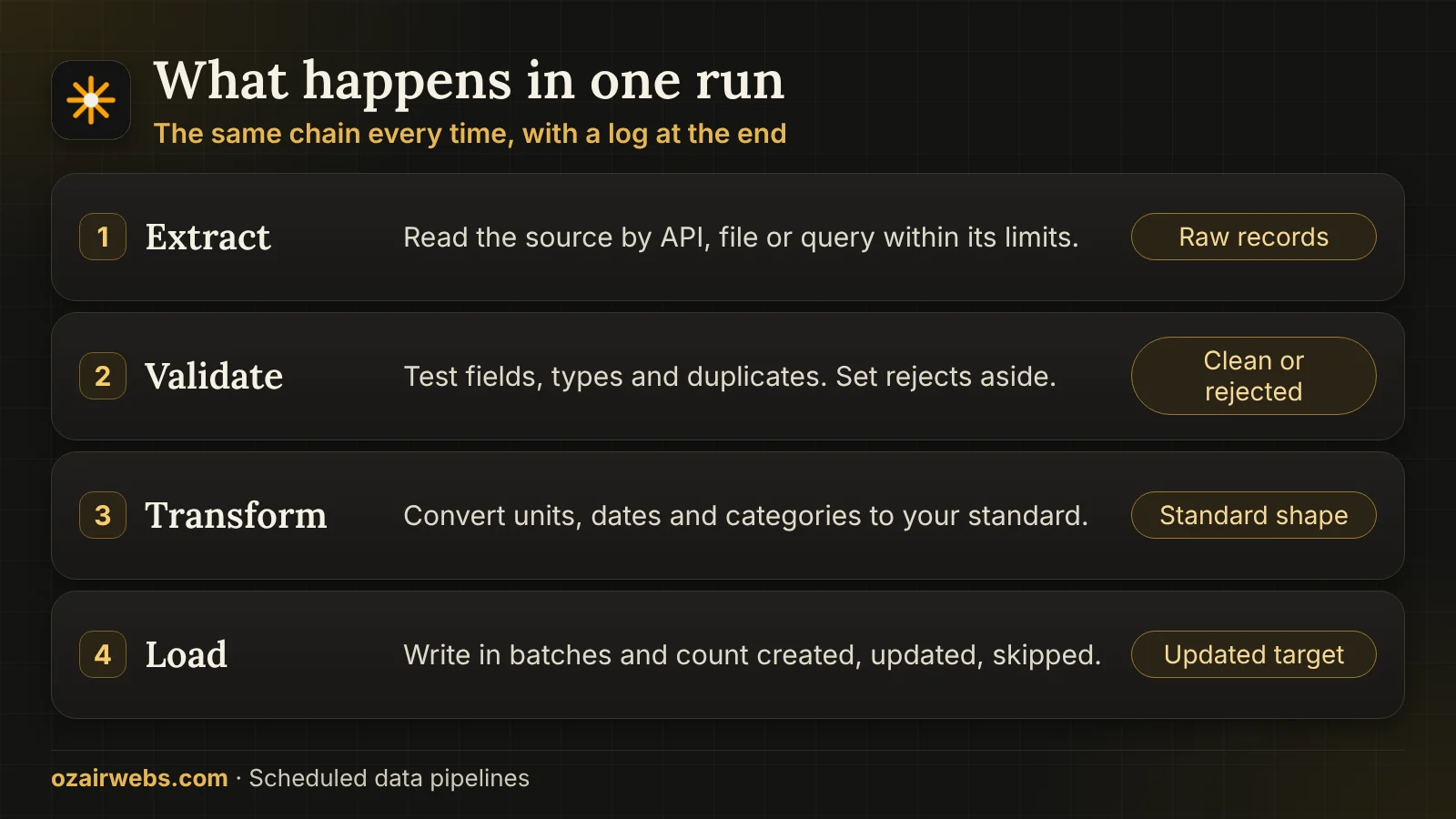
What happens inside one scheduled run.
Each run follows the same chain. Knowing it makes a failing import far easier to diagnose. Each stage writes to the log, so the point of failure is clear within minutes.
Stages we build into every run
- Extract. The source is read by API, file download, database query or webhook, with authentication and rate limits respected.
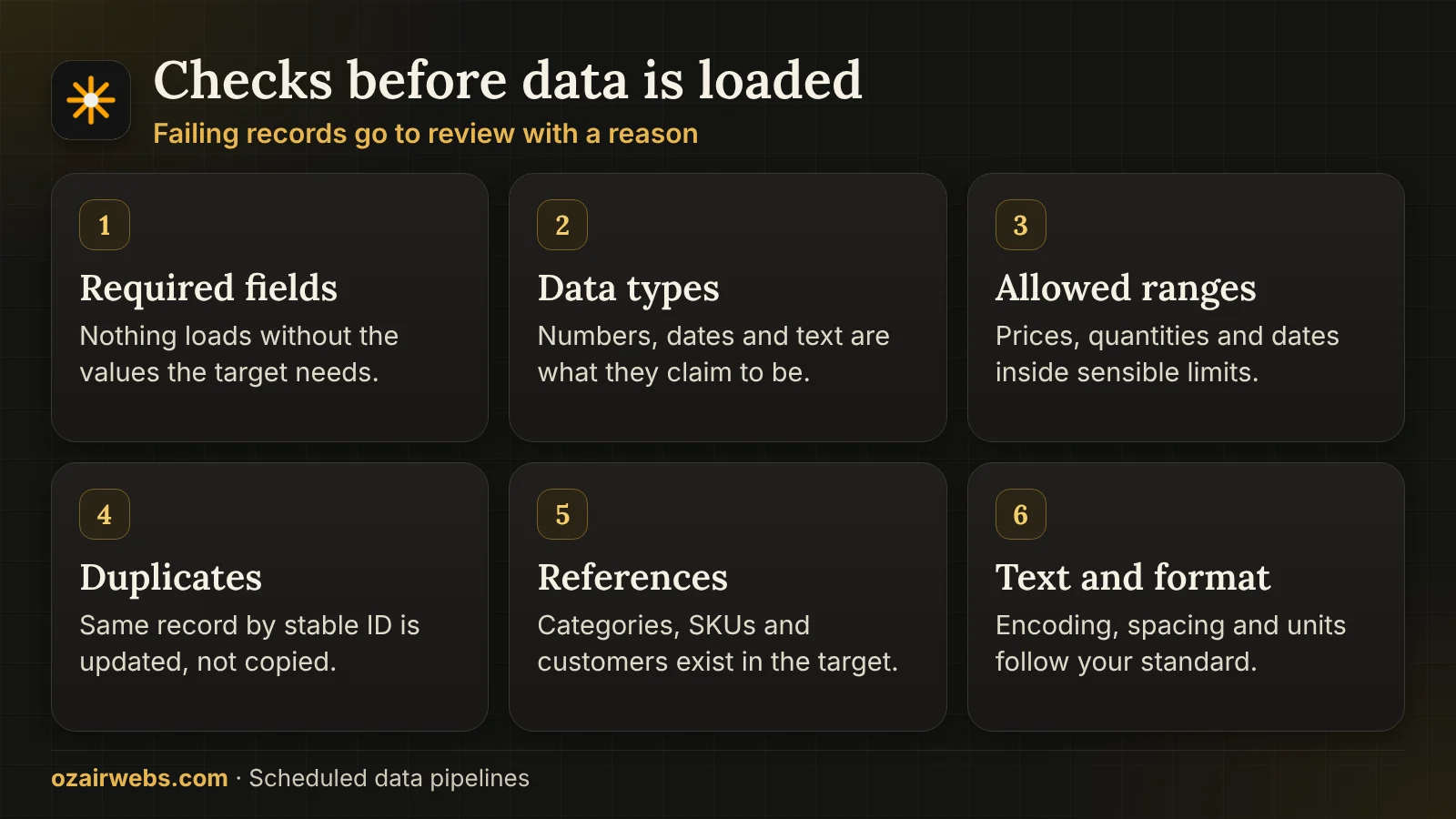
- Validate. Required fields, types, ranges and duplicates are tested. Records that fail are set aside with the reason, not dropped silently.
- Transform. Names, units, currencies, dates and categories are converted to your standard so downstream systems receive consistent data.
- Load and log. Clean records are written in batches, each run gets an identifier, and counts for created, updated, skipped and failed items are saved.
Timing matters too: a nightly run, an hourly poll and an event-driven webhook suit different sources, as the table below explains.
Polling, webhooks or a nightly batch?
How often data moves should follow how quickly anyone needs it, not how fast it is possible to move it. Faster is not always better, since every extra run adds load to the source and cost to you.
| Criteria | Scheduled batch | Frequent polling | Webhook or queue |
|---|---|---|---|
| Freshness of data | Hours to a day | Minutes | Near real time |
| Load on the source | Low | Moderate | Low |
| Complexity to build | Simple | Moderate | Higher |
| Handling an outage | Next run catches up | Next poll catches up | Needs replay support |
| Typical use | Reports and bulk imports | Stock and prices | Orders and alerts |
Validation and transformation done properly.
Automated imports fail quietly when the data is dirty. This part of the work absorbs what we used to offer as a separate data validation service. Rules are written down once and used both in the code and in the test suite.
How we keep bad data out
- A written data contract. Fields, types, allowed values and the meaning of empty are agreed with you and stored beside the code.
- Stable identifiers. Every record needs an identity that survives re-runs, such as a source ID or a SKU, so the same item is updated rather than duplicated.
- Quarantine for rejects. Records that fail checks go to a review table with a reason code, and a short report tells a person what needs fixing.
- Safe repeat runs. Running the same job twice gives the same result, which makes retries and manual re-runs harmless.
The same discipline applies to extraction from documents. See document intelligence.
Database synchronisation without surprises.
Two systems holding the same facts will drift apart unless someone decides which one is right. We make that decision explicit and then automate it. Most sync problems come from skipping that conversation, not from technical difficulty.
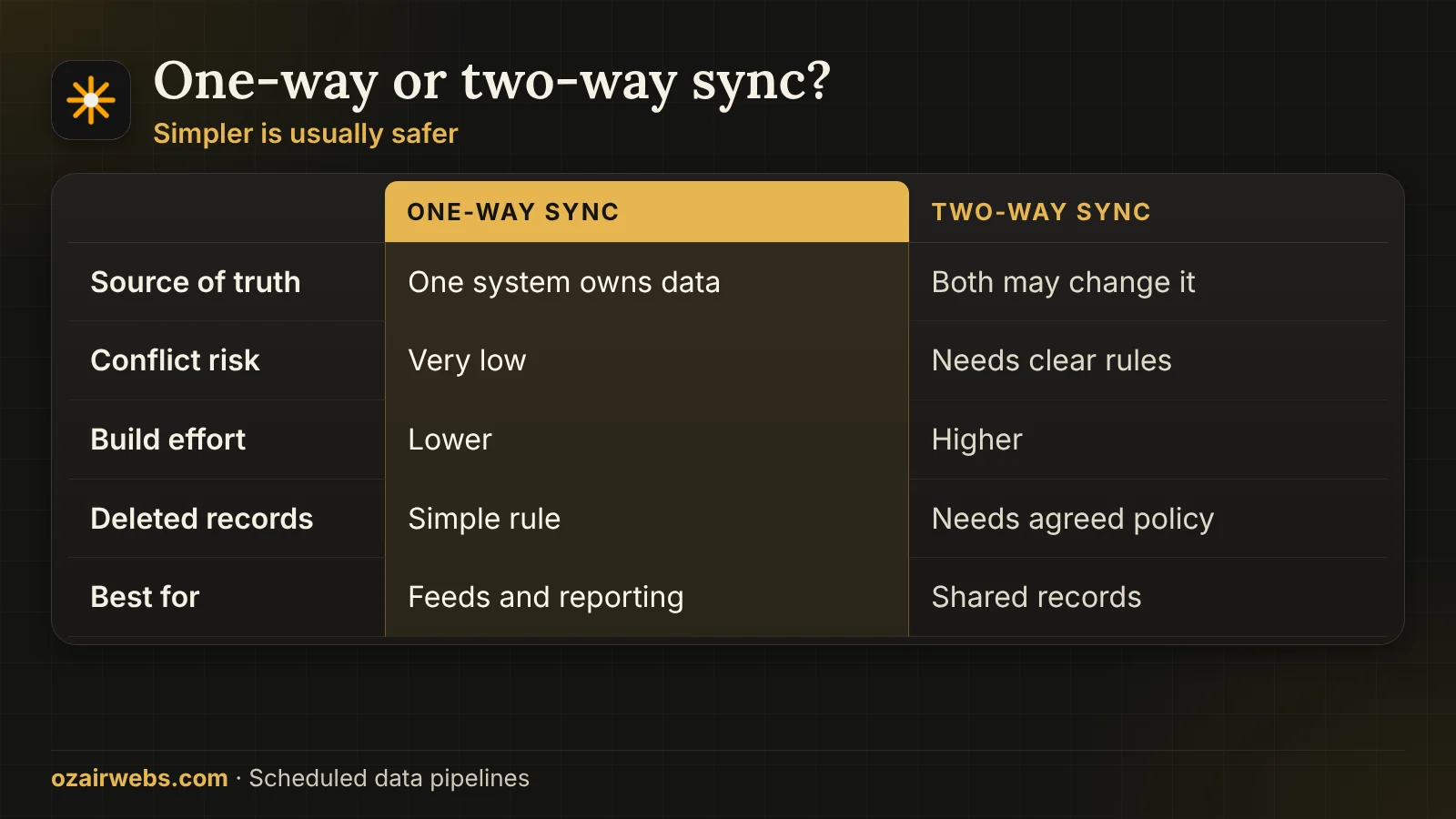
Rules we agree before building
- Source of truth. For each field, one system is the owner. Edits made elsewhere are either blocked, queued or overwritten by agreement.
- Direction and conflicts. One-way sync is simpler and safer. Two-way sync needs timestamps and clear rules for when both sides change.
- Deletions. Removing a record in one place may mean archive, hide or delete elsewhere. We decide this per entity, because mistakes here are hard to undo.
- Time zones and formats. Dates, currencies and text encodings are normalised, since mismatches cause many of the strangest sync bugs.
For shops that keep products in WordPress, see WordPress import and sync.
From messy source to a watched schedule.
Pipelines are built in a steady order so problems appear on a test copy, not in your live data. At each stage you see real counts from your own data, so progress is easy to judge.
- 01
Study the source
We read the feed or API documentation, sample real data and list odd cases such as missing fields, strange encodings and duplicates.
- 02
Define the mapping
A mapping document shows each source field, the destination field and the rule that links them, and you approve it.
- 03
Build on a test copy
The pipeline runs against a copy of your destination, so we can inspect results and compare counts safely.
- 04
Add logging and alerts
Run history, counts, error messages and notifications are added, including alerts for runs that did not start.
- 05
Compare and reconcile
A report lists records that differ between source and destination, and we investigate each difference type.
- 06
Schedule and hand over
The job is scheduled on a reliable runner, documented and handed over with clear owners for alerts.
Watching the pipeline after it goes live.
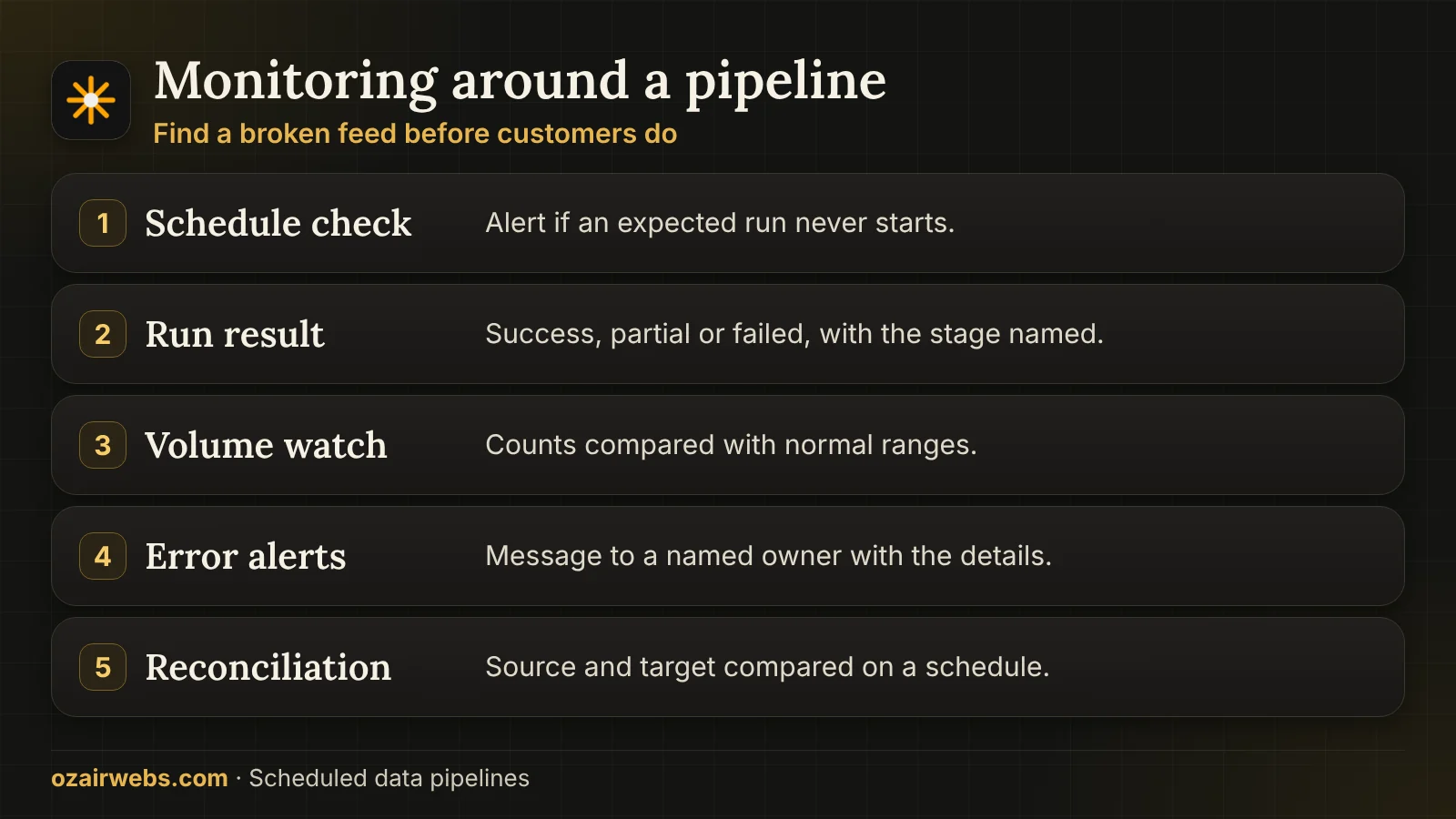
A silent pipeline is a dangerous one. Monitoring is how you find out about a broken feed before a customer does.
What we monitor and what drives cost
- Did it run? A missed schedule raises an alert, because the most common failure is the job that never started.
- Did the numbers make sense? A sudden drop in record counts or a spike in rejects usually means the source changed, and we flag it.
- Cost drivers. Number of sources, size of data, transformation rules and how many exceptions need human review move the price more than anything else.
- Runner and hosting. Cron, a queue worker, a workflow tool or a cloud scheduler each have different costs and failure modes, and we choose with you.
Visual tools are covered on our n8n automation page when a code-free runner is enough. Time zones, daylight saving shifts and slow public holidays on the source side are all tested, because they cause surprising gaps.
Data pipelines, your questions.
Straight answers to what clients ask before they start.
How often can a pipeline run?
As often as the source allows and you need. Many are nightly or hourly. If a provider limits requests or changes data slowly, running more often only costs money.
How do you stop duplicate records?
By giving each record a stable identifier and updating on that key instead of inserting blindly. Re-running a job then changes nothing that was already correct.
What if the source changes its format?
Validation catches the change on the first run, rejects the affected records and alerts you. We then adjust the mapping, and the rejected records are replayed.
Can you sync two databases in both directions?
Yes, but we often advise one-way sync with a clear source of truth, because two-way sync adds conflict rules and risk. If you need it, we design the rules first.
Where does the pipeline run?
On a server, a queue worker, a cloud scheduler or a workflow tool such as n8n. The choice depends on volume, your hosting and who will look after it.
How will I know a run failed?
You receive an alert by email or chat with the run identifier, the stage that failed and counts. There is also an alert if an expected run never starts.
Can you handle very large files?
Yes, by reading in batches and streaming instead of loading everything into memory. Very large or frequent loads are tested for speed and for their effect on the destination.
What does a pipeline project cost?
It depends on the number of sources and destinations, how messy the data is, how many validation rules and exceptions exist, how often it runs and what monitoring you want. We quote after sampling your real data.
Let the data move without you.
Tell us the source, the destination and how often the data should move. We will describe what could go wrong, how we would catch it and what the first version would include.